A letter (transcription below main article) from over 100 years ago relating to a significant event in the 18th Battalion’s service history overshadows the death of another soldier of the 18th Battalion.
Lieutenant Stuart Lowhall Gunn was all of 24 years young when he wrote this letter. He was a platoon leader with less than a month’s experience in war when he wrote this letter. In that short time, a popular officer, probably his Company Commander, was killed in action right beside him, by a sniper’s bullet that grazed Gunn’s ear, making it probable that the writer of the letter may have been the intended target of the German sniper.
He is writing to the McClary Wireless, which connects him to this, at the time, well-known London, Ontario manufactory as a clerk, the trade he indicated on his attestation papers, and the firm he worked for after the war until his retirement. The McClary Manufacturing Company, with roots dating from 1847, was a diverse manufacturing concern that concentrated in metal goods, from handheld coal shovels to cooking stoves. It was to later merge (1927) with four other similar firms to create General Steel Wares (GSW). This firm was to operate until 2013, when its last plant, in Fergus, Ontario, closed forever.
Gunn was a 1912 graduate of the Royal Military College and had prior military experience with the 1st Hussars. At the time enlistment, he was working at McClary’s.
As part of the original officers of the 18th Battalion, he would have known Captain Hallman well, and the impact of his death as the “first” fatal casualty of the war for the 18th Battalion would have had a strong impact.
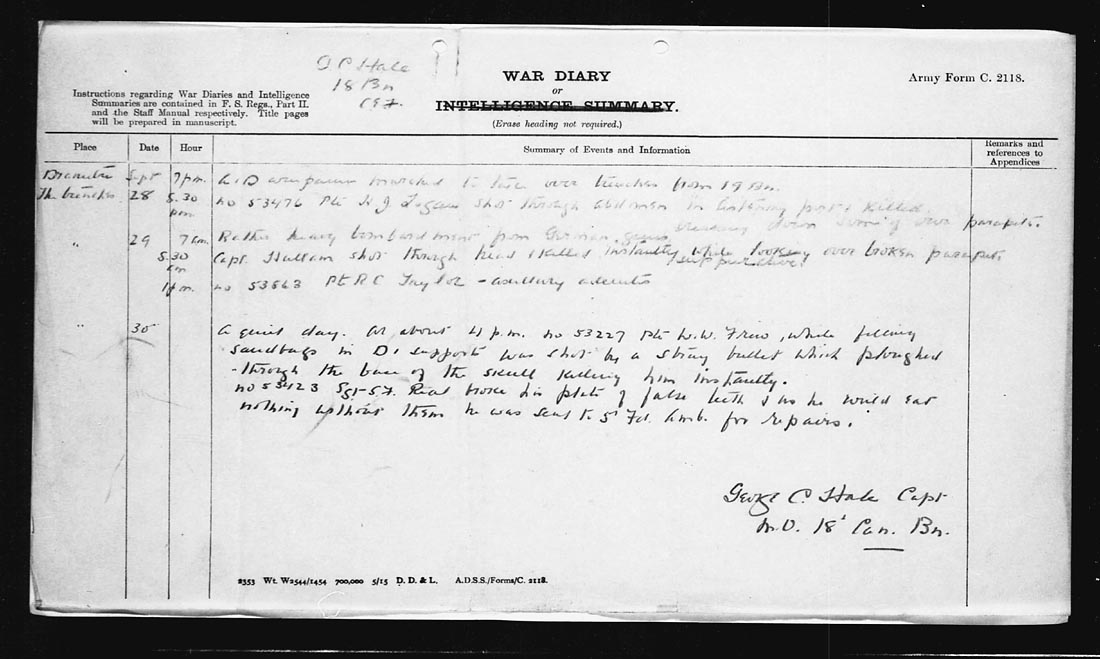
This death overshadows the loss the prior day of Private Herbert John Logan was wounded in action at approximately 9:30 PM September 28, 1915. This event is recorded in the Medical Officer’s War Diary with the following entry, “No. 53476 Pte HJ Logan shot through [illegible]…. reported killed.” The official Circumstances of Card gives the date of death as the next day and describes the circumstances thusly, ““Died of Wounds.” In the Field, Belgium. While on duty at a listening post thirty yards in front of our lines, at about 9.30 P.M. September 29th, 1915, he was wounded in the stomach by an enemy rifle bullet and died shortly afterwards.”
Upon re-examining the Medical Officer’s War Diary entry, the time entry for the log entry appears to reflect a number five or nine. Assuming consistency with the Circumstances of Death Card, the entry is probably using the number nine to represent the time of the event as 9:30 PM. A review of the description of the event offers the following narrative: “No. 53476 Pte HJ Logan shot through abdomen in [illegible – possibly sentry post]. Killed.”
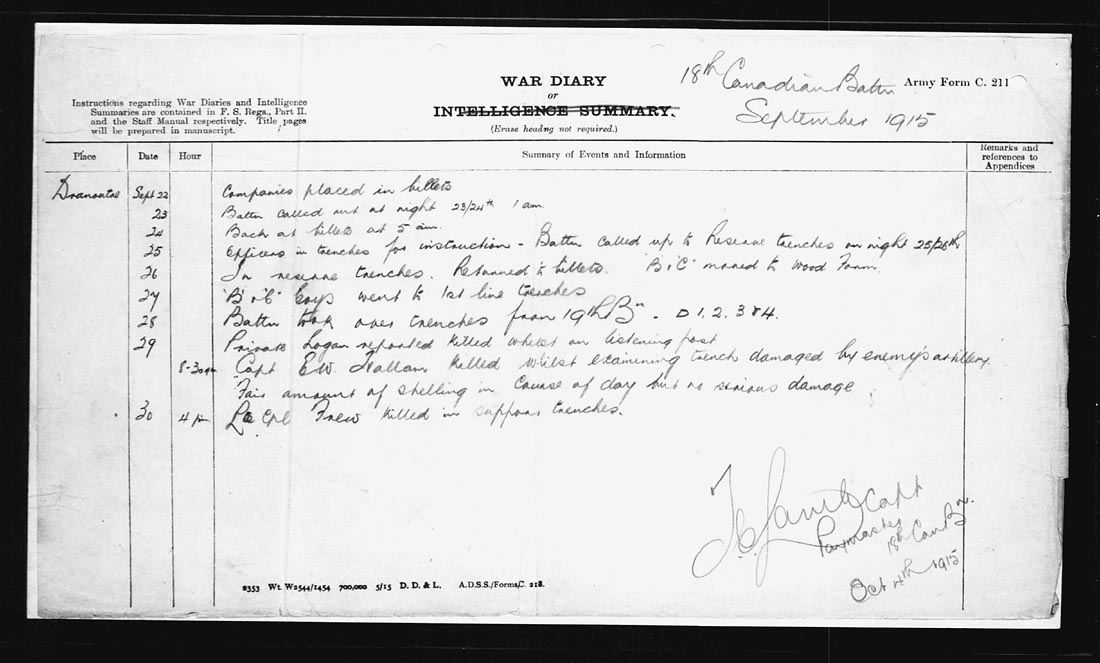
The military War Diary relates Private Logan’s death in the 29 September 1915 diary entry with the following entry, “Private Logan reported killed while on listening post. Capt. EW Hallam killed whilst examining trench damaged by enemy artillery. Fair amount of shelling in course of day but no serious damage.”
The official acknowledgement of Private Logan’s death is confused by the entry of the Circumstances of Death Card (died of wounds 29 September) and the entry the day before in the Medical Officer’s War Diary. The reason for this discrepancy is unknown, but it is possible that the delay in entering the information in each of the diaries made the death appear to occur on the 29th, perhaps after midnight of the 28th. All three documentary sources lack details that definitively determine when Logan died, but one can surmise that the Medical Diary would be more accurate as it was duty-bound to record the events involving the health and wellbeing of the 18th Battalion soldiers.
The 18th Battalion War Diary entry for 29 September does not elaborate on Logan’s death, and gets the cause of Captain Hallam’s death wrong, claiming he died from artillery fire, when an eyewitness in the form of Lieutenant Gunn and the Medical Officer’s War Diary Entry. In this case, the Circumstances of Death card simply states that Hallam was “Killed in Action”.
It is interesting to note that, to date, all the apparent attention to the “first” member of the 18th Battalion was focused on an officer. The evidence in the war diaries definitively tells a different story.
What would cause this lapse of recognition?
The distance in time from the event makes this difficult to answer. Certainly the publication of a letter would popularize the incident – so it could be simply that social media, as it was in 1915, created a projection bias. The publication of this letter and the affiliation between officers, the Battalion Medical Officer being one, with the addition of more than one witness to Captain Hallman’s death. It was immediate and shocking, whereas Private Logan appears to have been wounded and died of his wounds some unknown time after his wounding.
It was not a contest who would be killed in enemy action first. But it was inevitable that the wastage of men in war would begin soon after the 18th Battalion’s introduction into the wet, slimy trenches in the Ypres sector. It would be nice that the record reflected the correct order of the lost.
Private Logan was the first soldier to die in action. He would be followed by approximately 1,000 more men of the 18th to be killed in action or die of wounds due to action.
It is a cost we never should get used to.
LIEUT. GUNN TELLS OF CLOSE ESCAPES
Bullet That Killed Capt. Hallam Grazed His Ear, He Writes.
JUST DODGED SHELL, TOO
Interesting Letter Appears in McClary Company Publication From Londoner.
“McClary Wireless,” the breezy little publication of the McClary Manufacturing Company, in its latest issue has [an] interesting letter from Lieut. Stuart Gunn, 18th Battalion. It follows:
At last we are in the land of the [bi]g fight, and I must say I was not [so]rry to arrive. We got off in good [sty]le at 9:30 p.m. in darkness. About [fif]teen miles from our destination, we [we]re rammed by another boat which…
LIEUT. STUART GUNN,
18th Battalion, now in France.
…[ca]used great excitement. S. O. S. [ca]lls were sent out, and boats were on [ha]nd in ten minutes. Luckily it was a [sid]ewheeler, and the boat struck the [midd]le of the paddle wheel; otherwise we [mig]ht have been with Davy Jones. [Th]e other boat towed us to port. When [we] landed, nine men were absent, and [we] had given them up for lost; today [th]ey turned up, having jumped onto [th]e other boat in the excitement. The [be]havior of the men was simply mag-[nifi]cent, considering everyone thought [we] were going down.
At 5 p.m. we entrained, moving thirty [mi]les closer to the firing line. Here [we] had to march another eight miles [to] another camp, and I was never so [tir]ed in my life, getting to bed at 4 [a.]m. We could not find a billet, so […]ng and I slept in a graveyard, the [on]ly soft spot we could find. Here we [ha]d three hours sleep, waking up stiff [an]d sore from the pack, which by this [tim]e weighed about a ton. On arrival at our final destination we [we]re very weary. I never knew before [th]at it was to be fagged out, and I [ju]st flopped down on a bed and slept. [W]e saw a very exciting air fight to-[da]y; it was a long way off, but the [sh]ells were simply flying all around [th]e machine.
We had a little baptism of fire to-[da]y, several shells whizzing over our [hea]ds. The house we are billeted in is [th]e last inhabited house near the firing [lin]e.
[Yo]u never heard anything like the way [th]e French artillery go to it; their bat-[ter]ies from the noise they make must [fir]e about 200 shells a minute. The [noi]se of a shell coming is very weird. [Yo]u cannot see them, but you can al-[mo]st tell by the sound, how far they [ar]e going. All around where we were [wo]rking today, is plowed up by “Jack [Jo]hnsons”; the holes are big enough to [hol]d three teams of horses.
The spy system over here is wonder-[ful]. Before the battalion that we were [rel]ieving left their trenches, they were [tol]d by the Germans just when they [we]re going, and who was going to re-[lie]ve them. They seem to know even [be]fore we do, what is going to happen, [th]ey say our spy system is even better, [bu]t we got no news like that.
We got back from the trenches last [nig]ht, and I had the first good sleep in [fou]r nights. We will get another good [res]t tonight, and go up again to the [tre]nches tomorrow for another six days, [wh]en we will get about six days off in [bil]lets.
Bullet Grazed Ear.
Capt. Hallam was killed yesterday, [an]d we are all feeling very sad about [it]. He was the first man of the bat-[tal]ion to get it. The day before a shell [ha]d exploded on our front line, and [ha]d knocked down the parapet, which [ha]d to be repaired. He and I were [ex]amining the best way to fix it, when [he] was hit. It was quite a narrow [sq]ueak for me, as I was between Capt. [Ha]llam and the Germans; the bullet [gr]azed my ear, striking him. He is go-[in]g to be buried in the little village [ne]ar here where his brother is buried, [wh]o was killed last winter. He had just [m]ade arrangements for a small stone to [m]ark the place; little did he realize how [so]on he would be alongside of him.
Another Narrow Shave.
Later in the day, Sergt. Lee of my [pl]atoon, who worked at McClary’s, shot [th]e sniper who got him.
Sergt. Lee has accounted for about [se]ven Germans, himself. He is in charge [of] our snipers, and never misses an op-[por]tunity that is offered him. The Ger-[m]an snipers are very fond of getting [u]p in trees. At night we send up flares, [th]at light up the sky, and then pepper [of]f a few rounds to let them know we [a]re still alive.
I would give a good bit to crawl away [an]d have a good snooze now, but this is [ju]st about the time they start shelling [u]s, so I must stay awake.
We are having wonderful victories [no]w. Every day when the news comes [do]wn the line, there is loud cheering [fr]om the men in the trenches. Everyone [is] in the best of spirits, and aching for [a] chance to get out and get at them.
My servant had packed everything in [m]y sleeping bag, including your parcel, [an]d I have not seen the bag since; we [ha]ve been shifted around so much it [ha]s not reached me yet. I am anxious-[ly] waiting for my sleeping bag, so that [I] can get hold of my tobacco. I am [af]raid I will have to borrow a razor and [w]ash in rainwater; my whiskers are the [be]st I have seen yet.
On my way back to billets from the [tr]enches, I had just arrived at a certain [sp]ot which they had been shelling. I [wa]ited for five minutes to see if any [m]ore were coming; as I was in a hurry [to] get back, I started on my way, only [to] hear one coming through the air. One [c]an tell pretty well by the sound how [cl]ose they are coming, and instinct told [m]e this was coming to light not far from [m]e, so I just flopped down headfirst in [th]e ditch at the side of the road. Lucky [I] did, as it lit just on the road beside [th]e ditch where I lay. All I got was a [sh]ower of dirt, but I did not take long [to] get along the road a bit from there. [I]t was as close as I want one to come [t]o me. I must have been five miles [fr]om the gun; the hole it dug was big [e]nough to bury a horse in.
London Advertiser. 15 December 1915. Page 2.
Discover more from History of the 18th Battalion CEF, "The Fighting Eighteenth"
Subscribe to get the latest posts sent to your email.


Leave a Reply