ACROSS ATLANTIC WITH 18TH BATTALION; HEAVY SEAS CAUSED MUCH MAL-DE-MER; SOME THRILLING INCIDENTS OF THE VOYAGE; OFFICERS AND MEN IN PINK OF CONDITION
From the Time London Men Reached Halifax, Until the Good Ship Grampian Landed Them Safely on English Terra Firma, Pte. Bartlett Tells of the Adventures Met With, of the Feeling of Enthusiasm of the Volunteers, and of the Real Joy Engendered at the Fact That at Last the 18th Was Going to the Front to Show What Stuff It Was Made Off.
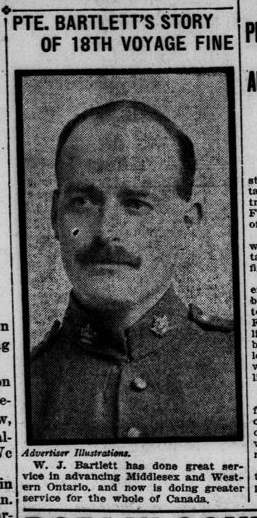
### (BY PTE. W. J. BARTLETT.) Written on board the R. M. S. Grampian.
“HERE WE ARE, HERE WE ARE, HERE WE ARE AGAIN. HELLO! HELLO! HELLO! HERE WE ARE AGAIN.”
What a simple song[i], the reader might think, especially when he or she is acquainted with the fact that it is the regimental song of the 18th Battalion.
But it is a simple song[ii] full of meaning. Ever since the battalion got into shape in London, the boys have stuck together in a remarkable way. Out on the heavy route marches, through snow, blizzards and rain, when the roll-call was taken the men were always there. And this is why the boys adopted the song, “Here We Are Again.”
Our Colonel has told us on many occasions he had faith in his men, that they would stand together through thick and thin. A very small number of people predicted that when the spring arrived many of the men would desert. But they know by this time how false was their prediction. All the men stand today, as they did months ago, shoulder to shoulder, ready to do or die for King and Empire, and this is why we shall go on singing wherever we go “Here We Are Again.”
Arrival Known of Before.
Readers of The Advertiser are no doubt aware by this time that the battalion arrived safely in Halifax at 4 a.m. Sunday, April 18.
When the train pulled into the station there was great rejoicing and excitement among the men. We were all sleepy and tired, but every man got out of his berth and let go some uproarious noises, sufficient, someone said, to frighten a German regiment. Indeed the coaches fairly seemed to shudder, and of course the regimental song, “Here We Are Again,” was heartily sung.
It was not until Sunday noon, however, that we received orders to put on our full packs and parade on the sidings outside the coaches. This was quickly done, and we were marched off to the dock where the transport ship, the R. M. S. Grampian, was waiting.
CLIMBED ABOARD IN RAIN.
In a heavy downpour of rain; the heaviest for many a day, officers and men climbed the gangways of the large steamer, and soon after everyone was quartered in his berthroom.
The time was about 6:30 o’clock that evening, when supper was on, that the loud blast of the steamer’s whistle was heard, and there was a wild rush for the top deck. The steamer was leaving port, and every member of the battalion was anxious to see the ship head for the open sea. The Grampian turned around gracefully—We were off! The rain had now gone, and it was in the flush of a beautiful spring evening that we cheered and waved our hands to the crowd that had come to bid us “God speed.”
Lieut.-Col. Wigle surveyed the impressive scene from the middle of the saloon deck, smiling and talking to his men. On one occasion he said:
“Well, boys, we are going this time. Are you sorry?”
Then from a thousand throats went up the glorious answer, “No, sir!”
JUST TWO WORDS, BUT—
Just two words, but with what feeling were they uttered! And who could have failed to observe the well-set jaws and piercing eyes of the men after they had spoken. It must have been a proud moment for our colonel to learn that his men were as keen as ever to do or die for their King and Empire.
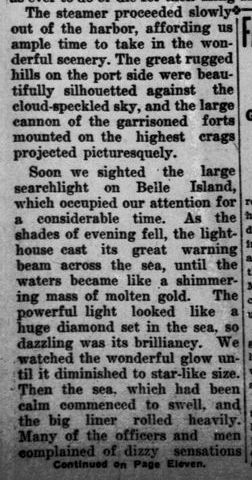
The steamer proceeded slowly out of the harbor, affording us ample time to take in the wonderful scenery. The great rugged hills on the port side were beautifully silhouetted against the cloud-speckled sky, and the large cannon of the garrisoned forts mounted on the highest crags projected picturesquely.
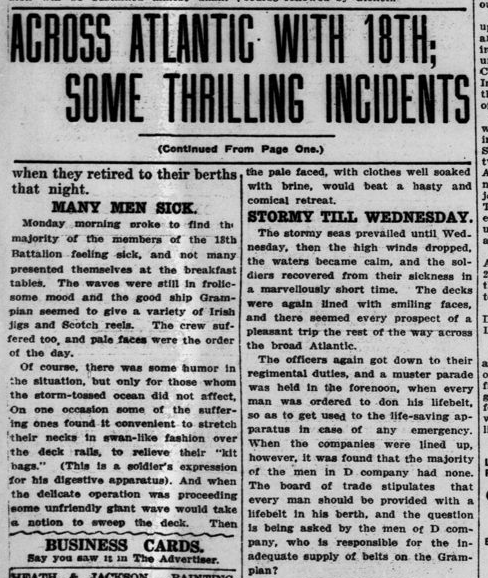
Soon we sighted the large searchlight on Belle Island, which occupied our attention for a considerable time. As the shades of evening fell, the lighthouse cast its great warning beam across the sea, until the waters became like a shimmering mass of molten gold. The powerful light looked like a huge diamond set in the sea, so dazzling was its brilliancy. We watched the wonderful glow until it diminished to star-like size. Then the sea, which had been calm commenced to swell, and the big liner rolled heavily. Many of the officers and men complained of dizzy sensations when they retired to their berths that night.
MANY MEN SICK.
Monday morning broke to find the majority of the members of the 18th Battalion feeling sick, and not many presented themselves at the breakfast tables. The waves were still in frolicsome mood and the good ship Grampian seemed to give a variety of Irish jigs and Scotch reels. The crew suffered too, and pale faces were the order of the day.
Of course, there was some humor in the situation, but only for those whom the storm-tossed ocean did not affect. On one occasion some of the suffering ones found it convenient to stretch their necks in swan-like fashion over the deck rails, to relieve their “kit bags.” (This is a soldier’s expression for his digestive apparatus). And when the delicate operation was proceeding some unfriendly giant wave would take a notion to sweep the deck. Then the pale faced, with clothes well soaked with brine, would beat a hasty and comical retreat.
STORMY TILL WEDNESDAY.
The stormy seas prevailed until Wednesday, then the high winds dropped, the waters became calm, and the soldiers recovered from their sickness in a marvellously short time. The decks were again lined with smiling faces, and there seemed every prospect of a pleasant trip the rest of the way across the broad Atlantic.
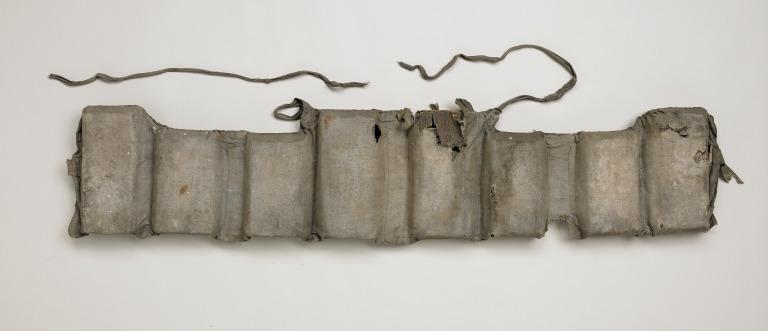
The officers again got down to their regimental duties, and a muster parade was held in the forenoon, when every man was ordered to don his lifebelt, so as to get used to the life-saving apparatus in case of any emergency. When the companies were lined up, however, it was found that the majority of the men in D company had none. The board of trade stipulates that every man should be provided with a lifebelt in his berth, and the question is being asked by the men of D company, who is responsible for the inadequate supply of belts on the Grampian?
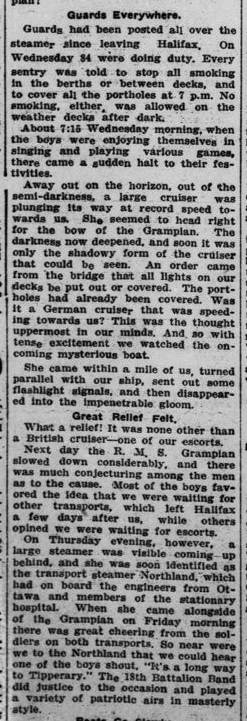
Guards Everywhere.
Guards had been posted all over the steamer since leaving Halifax. On Wednesday 84 were doing duty. Every sentry was told to stop all smoking in the berths or between decks, and to cover all the portholes at 7 p.m. No smoking, either, was allowed on the weather decks after dark.
About 7:15 Wednesday morning, when the boys were enjoying themselves in singing and playing various games, there came a sudden halt to their festivities.
Away out on the horizon, out of the semi-darkness, a large cruiser was plunging its way at record speed towards us. She seemed to head right for the bow of the Grampian. The darkness now deepened, and soon it was only the shadowy form of the cruiser that could be seen. An order came from the bridge that all lights on our decks be put out or covered. The portholes had already been covered. Was it a German cruiser that was speeding towards us? This was the thought uppermost in our minds. And so with tense excitement we watched the oncoming mysterious boat.
She came within a mile of us, turned parallel with our ship, sent out some flashlight signals, and then disappeared into the impenetrable gloom.
Great Relief Felt.
What a relief! It was none other than a British cruiser—one of our escorts.
Next day the R. M. S. Grampian slowed down considerably, and there was much conjecturing among the men as to the cause. Most of the boys favored the idea that we were waiting for other transports, which left Halifax a few days after us, while others opined we were waiting for escorts.
On Thursday evening, however, a large steamer was visible coming up behind, and she was soon identified as the transport steamer Northland, which had on board the engineers from Ottawa and members of the stationary hospital. When she came alongside of the Grampian on Friday morning there was great cheering from the soldiers on both transports. So near were we to the Northland that we could hear one of the boys shout, “It’s a long way to Tipperary.” The 18th Battalion Band did justice to the occasion and played a variety of patriotic airs in masterly style.
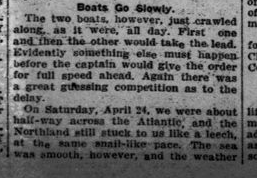
Boats Go Slowly.
The two boats, however, just crawled along, as it were, all day. First one and then the other would take the lead. Evidently something else must happen before the captain would give the order for full speed ahead. Again there was a great guessing competition as to the delay.
On Saturday, April 24, we were about half-way across the Atlantic, and the Northland still stuck to us like a leech, at the same snail-like pace. The sea was smooth, however, and the weather warm, so the men determined to make the best of things.
Sunday, the seventh day for us at sea, will be a day long remembered by the men of the 18th Battalion. It was about noon when some trailing smoke was seen on the horizon, and soon a large cruiser made her appearance. She must have been ten miles behind when first sighted, but she was coming up with amazing speed. The Northland and Grampian now raced ahead, but the cruiser was rapidly gaining on us. Our officers relieved our anxiety when they informed us she was the British cruiser Cumberland, which would escort us to the old land.
When the cruiser came near the two transports stopped, and an exchange of flag signals took place. It was soon seen that the battleship would pass on the starboard side of the Northland, which would check our view of the cruiser for a short time.
There were many stirring incidents when the cruiser arrived. One of the officers on the Grampian, with the red ensign in his hand, came aft, followed by hundreds of soldiers. The flag was going to be hoisted.
Funeral Silence.
There was a funeral silence when the good old flag was fastened to the ropes. But the next moment the flag was quickly raised, and then what an outburst of cheering! It thrilled one to the heart’s core to see the men of the 18th, everyone standing, cheer the flag, the flag that our forefathers won for us, the flag that we are going to fight under, the flag the German Emperor will never trample under his feet.
Some fifteen minutes passed, and a rowboat, manned by fifteen jolly blue-jackets and an officer from the cruiser, made its way over the choppy sea toward the Grampian. The plucky sailors came in for some deserving cheers, so skillfully did they handle the frail boat. With their mission accomplished they returned to the cruiser, which had left the Northland, and had taken up a position on our port side. With the battleship near, our band struck up that never-dying anthem, “Rule Britannia, Britannia Rules the Waves.” Never was the historic song played with more triumphant feeling; it stirred our patriotism to the utmost. And how true is that glorious anthem. There we were, in mid-ocean, at war with the great German nation, yet we were safe. Right true can be said, “Britannia rules the waves” today, more securely than ever.
Blood Riots In Veins.
Some signals were exchanged between the cruiser and the Grampian. One message from the battleship made the blood fairly leap in our veins. It read, “Congratulations on the gallantry of the Canadian troops in France.” Then the cruiser went slowly ahead of us, and our last signal was, “God save our King and empire.”
On Monday, April 26, the cruiser took up her position ahead, the Northland and the Grampian closely following, all in line. This position was maintained until Wednesday morning, when the Cumberland left us for Queenstown, Ireland. Two torpedo boat destroyers then came up quickly, one on each side of the transports, and acted as escorts.
It was a magnificent spectacle to watch the torpedo boats sweep the sea in search of German submarines. Sometimes they would go out a mile or two, but they would quickly come back. As we neared Lundy Island at the mouth of the Bristol Channel we were joined by a large fleet of destroyers. This was at 6 o’clock on Wednesday evening, and they safely escorted us up the channel, reaching Avonmouth about midnight.
The 18th Battalion disembarked at Avonmouth at 10 a.m. Thursday, April 28, and every officer and man was in the pink of condition, and quite ready to go into the training camp.
PTE. W. J. BARTLETT, No. 54110, D Company, 18th Battalion, G. P. O., London, England, 2nd C. E. F.
Pte. W. J. Bartlett was at one time a member of The Advertiser staff, but of recent years has been engaged in fruit farming near Byron. Although gone back to the soil, frequently he found time to write for this paper, and what he had to say was generally worth listening to.
London Advertiser May 12 1915 Page 1 and 11.
[i] https://folksongandmusichall.com/index.php/here-we-are-here-we-are-here-we-are-again/?print=print
Discover more from History of the 18th Battalion CEF, "The Fighting Eighteenth"
Subscribe to get the latest posts sent to your email.


Leave a comment